
Diploma in Mechanical Engineering
(R3/521/4/0019)(01/28)(A6703)
Professional Recognition
Malaysian Qualification Agency (MQA) (R3/521/4/0019)(01/28)(A6703)
Tuition Fee
Local student – RM 22 303 *
International – RM 36 289 *
* The policies, regulations,procedures and fees are subject to change without prior notice of Unisel
- 3 Years / 6 Semester
- Intakes: Apr, August, November
Overview
The Diploma in Mechanical Engineering is more than just a study program — it’s a stepping stone to an exciting career in engineering. Designed to build a strong foundation in science and mechanical principles, the program also encourages innovative thinking, ethical values, and environmental responsibility. Students don’t just learn theory — they apply it. From day one, they gain practical skills to solve real problems, lead teams, troubleshoot systems, and manage machinery. The highlight of the program is a 16-week industrial attachment, where students step into the real world of engineering, working with professionals to tackle actual challenges. It’s the perfect blend of classroom learning and hands-on experience, preparing graduates to thrive in today’s fast-paced engineering industry.
Career Opportunities
Graduates of the Diploma in Mechanical Engineering program have a wide range of career opportunities in various industries. With strong technical skills and industry exposure, they are well-equipped for roles such as:
- Mechanical Engineering Technician – Assisting engineers in designing, testing, and maintaining mechanical systems.
- Maintenance Technician – Performing maintenance, troubleshooting, and repair of machinery and equipment in manufacturing plants.
- Production Supervisor – Overseeing manufacturing processes to ensure efficiency, quality, and safety compliance.
- Automotive Technician – Working in vehicle design, testing, and maintenance within the automotive industry.
- CNC Machinist/Technician – Operating and programming Computer Numerical Control (CNC) machines for precision manufacturing.
- Quality Control Inspector – Ensuring that products and components meet industry standards and specifications.
- Manufacturing Technician – Assisting in the production and assembly of mechanical components and systems.
- HVAC Technician – Installing, maintaining, and repairing heating, ventilation, and air conditioning systems.
- Technical Sales Representative – Providing technical knowledge and support in selling mechanical equipment and products.
- Field Service Technician – Conducting on-site servicing, repairs, and maintenance of mechanical systems and equipment.
Program Highlights
The Diploma in Mechanical Engineering program is structured to provide students with a strong foundation in engineering principles while integrating hands-on experience and industry-relevant skills. The curriculum is designed to meet the demands of the evolving mechanical engineering industry, focusing on both theoretical knowledge and practical applications. Key highlights include:
- Fundamental & Applied Engineering Knowledge:
Students gain essential knowledge in thermofluids, materials science, mechanical design and manufacturing process. The curriculum also includes specialized modules in engineering drawing, instrumentation, and machine elements, ensuring students develop a well-rounded understanding of core mechanical engineering concepts. - Practical & Hands-On Learning:
The program emphasizes laboratory experiments, prototype development, and mechanical system testing to reinforce theoretical knowledge. Students are trained in industry-relevant software such as AutoCAD and simulation tools, equipping them with skills required for design and analysis in real-world applications. - Project-Based Learning (PBL):
To enhance problem-solving and teamwork skills, students engage in Final Year Project (FYP), where they work on real-world engineering challenges. These projects allow students to apply their technical knowledge in design, fabrication, testing, and troubleshooting of mechanical systems. - Industrial Training & Industry Exposure:
A key component of the diploma program is the mandatory industrial attachment, where students undergo practical training with engineering firms. This experience allows them to apply classroom knowledge in professional settings, develop workplace competencies, and gain exposure to industry best practices.
Program Structure
YEAR 1
Mathematics
Physics
Engineering Drawing
Chemistry
Statics
Thermodynamics
Material Science
Mechanical Workshop 1
YEAR 2
Strength of Material
Dynamics
Manufacturing Process
Applied Thermodynamics
Mechanical Workshop 2
Electrical Technology
Fluid Mechanics
Mechanic of Machines
Computer Programming & Application
Entrepreneurship
Computer Aided Design (CAD)
YEAR 3
Computer Aided Manufacturing (CAM)
Machine Design
Instrumentation and Measurement
Fluid Power
Project Management
Engineering Project
Industrial Training
TOTAL CREDIT HOURS: 97
Programme Educational Objectives
The programme is committed to produce:
PEO | Statement |
PEO1 | graduates who are able to apply relevant engineering fundamentals and technical knowledge in engineering practise. |
PEO2 | graduates who are technically competent with multi-tasking and communication skills. |
PEO3 | graduates who practice life-long learning, highly ethical, professional and environmentally conscious. |
PEO4 | graduates with entrepreneurship skills, who can function as leaders as well as good team players. |
(for year 2027 intake onwards)
The programme is committed to produce technicians who are:
PEO | Statement |
PEO1 | knowledgeable and technically competent in Mechanical Engineering profession or in other related fields they choose to pursue. |
PEO2 | capable of demonstrating leadership skills, both in their chosen profession and in community at large. |
PEO3 | actively engaged in lifelong learning activities for successful career advancement. |
Programme Learning Outcomes
Upon graduation, our Diploma graduates will be able:
PLO1 | Knowledge: Apply knowledge of applied mathematics, applied science, computing and engineering fundamentals and an engineering specialisation as specified in DK1 to DK4 respectively to wide practical procedures and practices; |
PLO2 | Problem analysis: Identify and analyse well-defined engineering problems reaching substantiated conclusions using codified methods of analysis specific to their field of activity (DK1 to DK4); |
PLO3 | Design/development of solutions: Design solutions for well-defined technical problems and assist with the design of systems, components or processes to meet specified needs with appropriate consideration for public health and safety, as well as cultural, societal, and environmental considerations as required (DK5); |
PLO4 | Investigation: Conduct investigations of well-defined problems; locate and search relevant codes and catalogues, conduct standard tests and measurements (DK8); |
PLO5 | Tool Usage: Apply appropriate techniques, resources, and modern engineering computing and IT tools to well-defined engineering problems, with an awareness of the limitations (DK2 and DK6); |
PLO6 | The Engineering Technician and the World: Consider sustainable development impacts* to: society, the economy, sustainability, health and safety, legal frameworks, and the environment, in solving well-defined engineering problems (DK1, DK5, and DK7); |
PLO7 | Ethics: Understand and commit to professional ethics and responsibilities and norms of technician practice and including compliance with national and international laws. Demonstrate an understanding of the need for diversity and inclusion; (DK9) |
PLO8 | Individual and Collaborative Team Work: Function effectively as an individual, and as a member in diverse and inclusive teams in multi-disciplinary, face-to-face, remote and distributed settings; (DK9) |
PLO9 | Communications: Communicate effectively and inclusively on well-defined engineering activities with the engineering community and with society at large, by being able to comprehend the work of others, document their own work, and give and receive clear instructions; |
PLO10 | Project Management and Finance: Demonstrate awareness of engineering management principles as a member or leader in a technical team and to manage projects in multidisciplinary environments; |
PLO11 | Life Long Learning: Recognize the need for, and have the ability for i) independent and life-long learning and ii) critical thinking in the face of specialised technical knowledge; (DK8) |
Entry Requirements
LOCAL:
- Passed the Malaysian Certificate of Education (SPM) or equivalent, with a minimum of three (3) credits, including Mathematics and one (1) subject related to Science/Technical/Vocational, and a pass in English; or
- Passed the Malaysian Higher School Certificate (STPM) or equivalent, with passes in Mathematics, English, and one (1) Science/Technical/Vocational subject at the SPM level; or
- Passed a Certificate in Engineering/Engineering Technology program with a CGPA of 2.0 and above from a recognised institution by the Government of Malaysia; or
- Passed a recognised Vocational and Technical/Skills Certificate program or its equivalent, with one (1) year of relevant working experience, or at least one (1) semester of a bridging program; or
- Other equivalent qualifications recognised by the Malaysian Government.
INTERNATIONAL:
- Secondary school or equivalent AND score 500 in the Test of English as a Foreign Language (TOEFL) OR
- Score 5.0 in the International English Language Testing System (IELTS) OR equivalent.
- If the student does not meet the criteria, the HEP must offer an English course to ensure the student’s proficiency in order to meet the program requirements. This is usually done through an assessment process.
Do you have more questions?

Need Help?
Coordinator of Programme
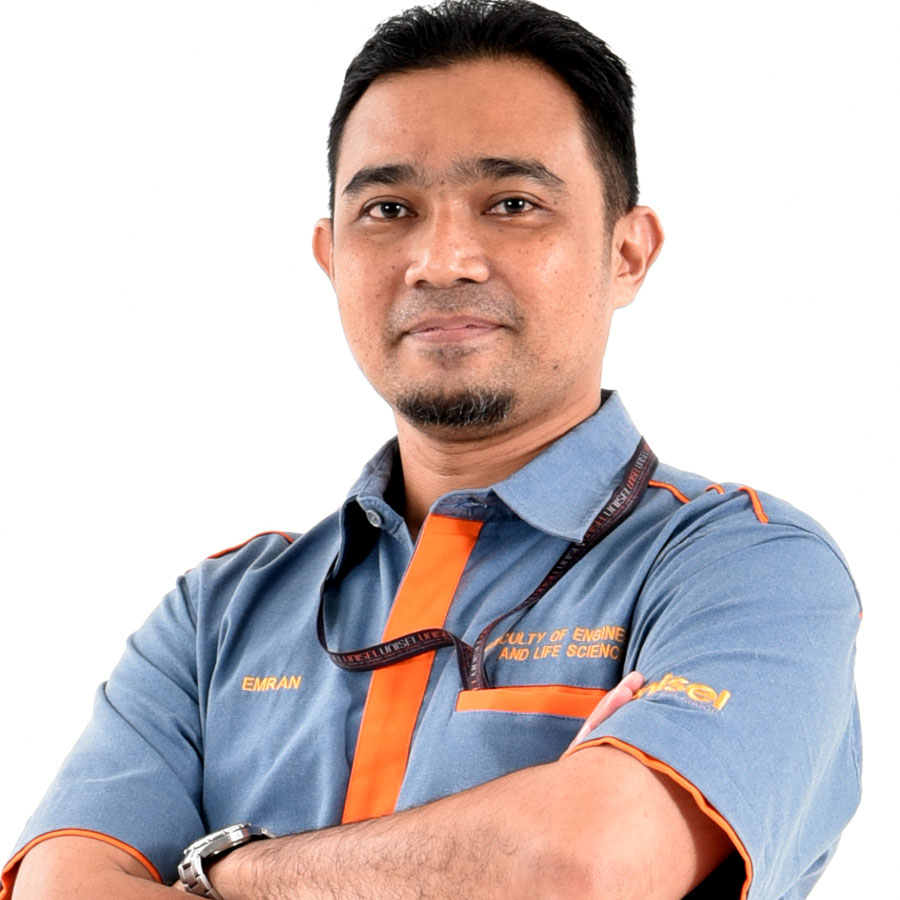
Ts. Mohammad Emran Bin Rusli
- Email: emran_rusli@unisel.edu.my
- [Google Scholar] [Research Gate] [CV]